How Robotics Are Transforming Manufacturing in the USA
Introduction
Robotics has become one of the most influential technologies shaping the future of manufacturing in the United States. As industries strive to improve productivity, reduce costs, and maintain global competitiveness, robots are increasingly being integrated into factories and production facilities. From assembling automobiles and electronics to packaging food products and inspecting equipment, robotics is revolutionizing nearly every aspect of modern manufacturing.
In 2026, American manufacturers are embracing advanced robotics alongside artificial intelligence (AI), machine learning, and the Industrial Internet of Things (IIoT) to create smarter, faster, and more efficient production systems. These innovations are helping companies meet growing consumer demand while improving workplace safety and product quality.
The Rise of Industrial Robotics
Industrial robots have been used in manufacturing for decades, but today’s robotic systems are far more advanced than their predecessors. Modern robots are equipped with intelligent sensors, high-speed processors, and AI-powered software that allow them to perform complex tasks with incredible precision.
Unlike traditional machines designed for a single function, today’s robots can adapt to changing production requirements, learn from data, and collaborate with human workers. This flexibility enables manufacturers to produce a wider range of products while maintaining high efficiency.
As technology becomes more affordable, robotics adoption is expanding beyond large corporations to include small and medium-sized manufacturers across the United States.
Increasing Productivity and Efficiency
One of the biggest advantages of robotics is the significant increase in productivity. Robots can work continuously without fatigue, allowing factories to operate around the clock with minimal downtime.
Automated production lines perform repetitive tasks much faster than manual labor while maintaining consistent quality. This enables manufacturers to produce more goods in less time and meet increasing market demand.
Robotic automation also reduces production delays caused by human error, equipment inefficiencies, or labor shortages. As a result, businesses improve operational performance and achieve greater profitability.
Improving Product Quality
Consistency is essential in manufacturing, and robotics plays a vital role in maintaining high product quality. Human workers may experience fatigue or make occasional mistakes during repetitive tasks, but robots perform the same operation with exceptional precision every time.
Robotic systems are widely used for welding, painting, assembly, cutting, and packaging because they produce highly accurate results. Advanced vision systems allow robots to inspect products for defects, ensuring that only high-quality items reach customers.
This improved quality control reduces waste, lowers production costs, and enhances customer satisfaction.
Enhancing Workplace Safety
Manufacturing environments often involve hazardous tasks, including handling heavy machinery, toxic chemicals, high temperatures, and dangerous materials. Robotics helps reduce workplace injuries by taking over these high-risk activities.
Robots can safely lift heavy loads, operate in extreme environments, and perform repetitive motions that could otherwise lead to worker fatigue or musculoskeletal injuries.
By assigning dangerous jobs to robotic systems, manufacturers create safer workplaces while allowing employees to focus on higher-value tasks such as programming, maintenance, quality assurance, and process improvement.
Collaborative Robots (Cobots)
One of the fastest-growing trends in American manufacturing is the adoption of collaborative robots, commonly known as cobots. Unlike traditional industrial robots that operate inside safety cages, cobots are designed to work alongside human employees.
Cobots are equipped with advanced sensors that detect nearby workers and automatically adjust their movements to ensure safety. They assist employees with repetitive or physically demanding tasks while allowing humans to handle decision-making and complex problem-solving.
This collaboration improves productivity without replacing the human workforce entirely, making manufacturing more efficient and flexible.
Artificial Intelligence and Smart Robotics
Artificial intelligence has significantly expanded the capabilities of modern robotics. AI-powered robots can analyze production data, recognize patterns, detect equipment failures, and optimize manufacturing processes in real time.
Machine learning algorithms enable robots to improve performance through experience rather than relying solely on pre-programmed instructions. This adaptability allows manufacturers to respond quickly to changing customer demands and production requirements.
Smart robotics also supports predictive maintenance by identifying potential equipment problems before they cause costly breakdowns. This minimizes downtime and extends the lifespan of manufacturing equipment.
Supporting Supply Chain Operations
Robotics is transforming supply chain management by improving inventory handling, warehouse operations, and product distribution. Automated guided vehicles (AGVs) and autonomous mobile robots transport materials throughout manufacturing facilities with speed and accuracy.
Warehouse robots efficiently sort, store, and retrieve products while reducing labor-intensive tasks. Automated inventory systems provide real-time tracking, helping manufacturers maintain accurate stock levels and avoid supply shortages.
These improvements create more efficient supply chains that deliver products to customers faster while reducing operational costs.
Robotics in Key American Industries
Many industries across the United States are benefiting from robotic automation.
Automotive Manufacturing
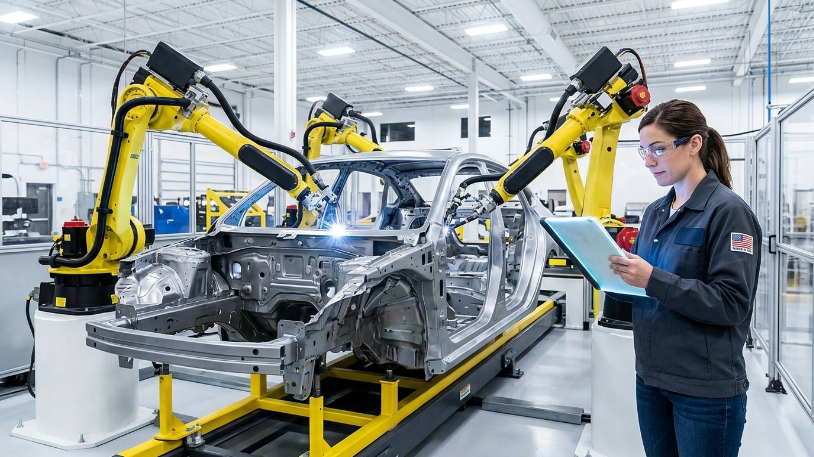
The automotive industry remains one of the largest users of industrial robots. Robots perform welding, painting, assembly, quality inspections, and material handling with exceptional precision. This improves vehicle quality while increasing production efficiency.
Electronics Manufacturing
Electronics manufacturers rely on robotics to assemble delicate components found in smartphones, computers, and consumer electronics. Precision robotics ensures accurate placement of tiny parts that would be difficult to assemble manually.
Food and Beverage Industry
Food manufacturers use robots for packaging, sorting, palletizing, and quality inspections. Automation helps maintain hygiene standards while increasing production speed and reducing waste.
Aerospace Manufacturing
The aerospace industry uses robotics to manufacture aircraft components requiring extreme precision. Robots assist with drilling, fastening, welding, and composite material handling to improve safety and reliability.
Addressing Labor Shortages
Many American manufacturers face ongoing labor shortages due to an aging workforce and increasing demand for skilled workers. Robotics helps fill these gaps by automating repetitive tasks that are difficult to staff.
Rather than replacing workers entirely, automation allows employees to focus on technical roles such as robot programming, maintenance, engineering, and quality management.
As manufacturing evolves, demand continues to grow for workers with skills in robotics, automation, artificial intelligence, and data analysis.
Challenges of Robotics Adoption
Although robotics offers numerous advantages, implementation comes with challenges. Purchasing robotic systems and integrating them into existing production lines requires significant investment.
Small manufacturers may face financial barriers when adopting advanced automation technologies. Employee training is also essential to ensure workers can operate and maintain robotic equipment effectively.
Cybersecurity has become another important concern as connected robotic systems become part of digital manufacturing networks. Companies must protect these systems from cyber threats that could disrupt operations.
Despite these challenges, falling technology costs and increasing productivity gains continue to encourage wider robotics adoption.
The Future of Robotics in American Manufacturing
The future of robotics in the United States is extremely promising. Advances in artificial intelligence, machine learning, computer vision, and autonomous systems will make robots even more capable and intelligent.
Factories of the future will feature highly connected smart manufacturing environments where robots, sensors, machines, and software communicate seamlessly. Predictive analytics, digital twins, and real-time monitoring will further optimize production efficiency.
As technology continues to advance, robotics will remain a key driver of innovation, helping American manufacturers compete in an increasingly global economy while producing safer, higher-quality products.
Conclusion
Robotics is transforming manufacturing in the USA by improving productivity, enhancing product quality, increasing workplace safety, and supporting smarter production systems. From automotive factories to food processing plants, robotic technology is enabling businesses to operate more efficiently while meeting growing consumer demand.
Although challenges such as implementation costs and workforce training remain, the long-term benefits of robotics far outweigh the obstacles. As artificial intelligence and automation technologies continue to evolve, robotics will play an even greater role in shaping the future of American manufacturing, driving innovation, economic growth, and global competitiveness for years to come.