How Blockchain Technology Is Changing Industries in America
Introduction
Blockchain technology has emerged as one of the most transformative innovations of the digital age. Originally developed as the underlying technology for cryptocurrencies, blockchain has evolved far beyond digital currencies and is now reshaping industries across the United States. Its ability to provide secure, transparent, and decentralized record-keeping is helping businesses improve efficiency, reduce costs, and build trust among customers and partners.
In 2026, organizations across America are increasingly adopting blockchain solutions to streamline operations, enhance security, and create new opportunities for innovation. From finance and healthcare to supply chain management and real estate, blockchain technology is changing how industries operate and interact in the modern economy.
Understanding Blockchain Technology
Blockchain is a decentralized digital ledger that records transactions across multiple computers. Instead of storing information in a single central database, blockchain distributes data across a network of participants. Each transaction is grouped into a block, and these blocks are linked together in a chronological chain.
This structure makes blockchain highly secure because altering a record requires changing every subsequent block across the entire network. The technology provides transparency, accuracy, and resistance to fraud, making it valuable for a wide range of business applications.
Transforming the Financial Industry
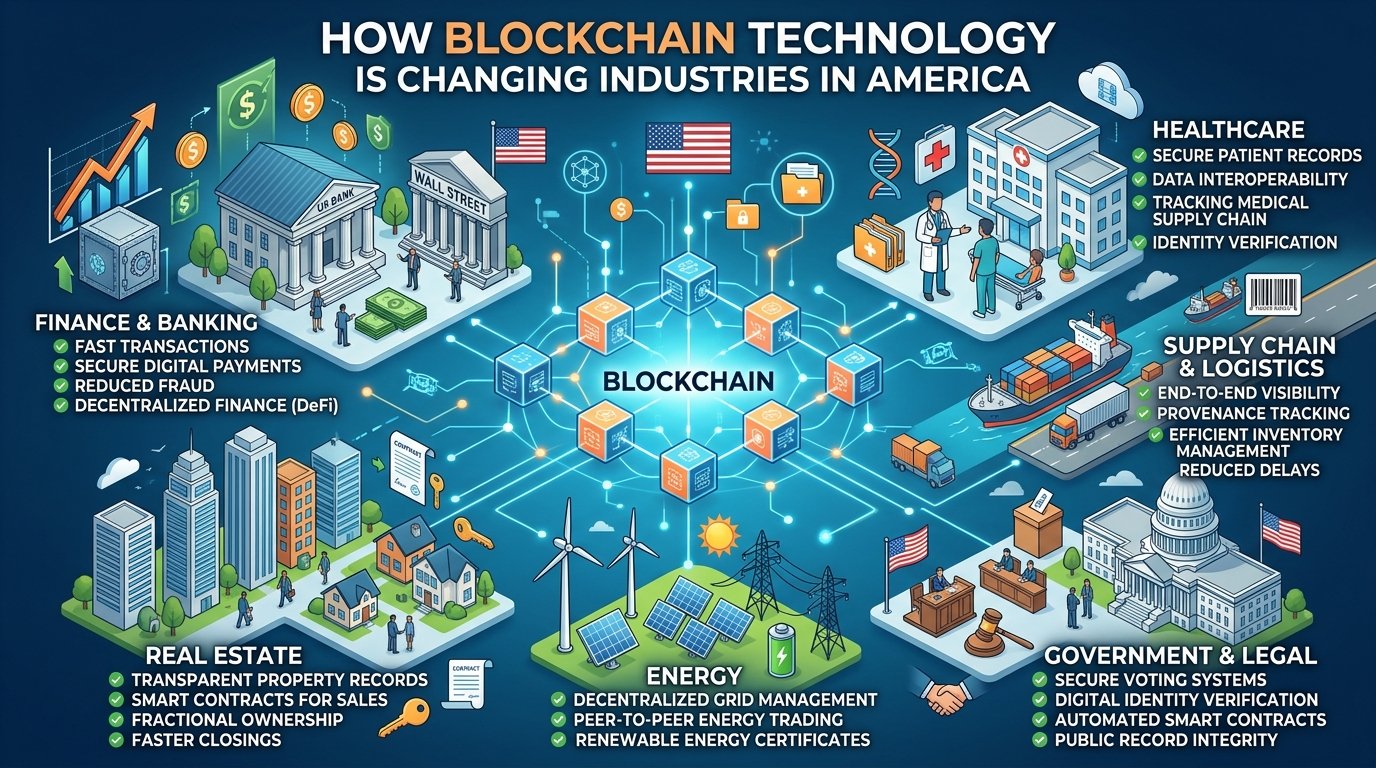
The financial sector has been one of the earliest adopters of blockchain technology in America. Banks, investment firms, and payment providers are using blockchain to improve transaction speed, security, and efficiency.
Traditional financial transactions often require intermediaries and can take several days to process. Blockchain enables near-instant transactions by eliminating unnecessary middlemen and automating verification processes. This reduces costs and improves customer experiences.
Financial institutions are also using blockchain to enhance fraud prevention, improve regulatory compliance, and increase transparency in financial operations. As a result, blockchain is helping modernize the American financial system.
Improving Supply Chain Management
Supply chain management is another area where blockchain is making a significant impact. Businesses often struggle to track products as they move through complex supply chains involving multiple suppliers, manufacturers, distributors, and retailers.
Blockchain creates a transparent and tamper-resistant record of every transaction and movement within the supply chain. Companies can monitor products in real time, verify authenticity, and identify issues more quickly.
For consumers, blockchain provides greater confidence in product quality and origin. For businesses, it improves efficiency, reduces fraud, and strengthens accountability throughout the supply chain process.
Enhancing Healthcare Systems
Healthcare organizations across the United States are exploring blockchain solutions to improve data management and patient care. Medical records are often stored in multiple systems, making information sharing difficult and increasing the risk of errors.
Blockchain can create secure and unified patient records that authorized healthcare providers can access when needed. This improves coordination among doctors, hospitals, and specialists while maintaining patient privacy.
The technology also helps protect sensitive medical information from unauthorized access and cyberattacks. Additionally, blockchain can streamline insurance claims processing and reduce administrative costs within the healthcare industry.
Revolutionizing Real Estate Transactions
The real estate industry is benefiting from blockchain technology through faster and more secure property transactions. Traditional real estate deals involve extensive paperwork, multiple intermediaries, and lengthy verification processes.
Blockchain enables digital property records that are secure, transparent, and easily accessible. Buyers, sellers, lenders, and government agencies can verify ownership information more efficiently.
Smart contracts, which automatically execute agreements when specific conditions are met, are also simplifying real estate transactions. These innovations reduce paperwork, lower costs, and accelerate the buying and selling process.
Supporting Government Services
Government agencies in the United States are exploring blockchain technology to improve transparency, security, and efficiency in public services. Blockchain can help manage records, verify identities, and reduce administrative fraud.
For example, blockchain-based systems can improve voting security, ensure accurate record-keeping, and enhance public trust in government operations. Secure digital identities can also make it easier for citizens to access government services online.
By reducing paperwork and increasing transparency, blockchain has the potential to modernize public administration and improve service delivery.
Strengthening Cybersecurity
Cybersecurity remains a major concern for businesses and organizations across America. Blockchain offers unique security advantages that help protect sensitive information from cyber threats.
Because blockchain records are decentralized and encrypted, they are difficult for hackers to alter or manipulate. The technology reduces the risk of unauthorized access and improves data integrity.
Organizations are increasingly integrating blockchain into cybersecurity strategies to secure digital identities, protect financial transactions, and strengthen network security. As cyber threats continue to evolve, blockchain provides an additional layer of protection.
Transforming the Energy Sector
The energy industry is also experiencing significant changes through blockchain adoption. Energy companies are using blockchain to improve efficiency, monitor energy usage, and facilitate peer-to-peer energy trading.
Consumers with renewable energy sources such as solar panels can sell excess energy directly to others using blockchain-based platforms. Smart contracts automate these transactions and ensure accurate payments.
Blockchain also helps energy providers track renewable energy production and maintain transparent records for regulatory compliance. These innovations support sustainability efforts while improving operational efficiency.
Driving Innovation Through Smart Contracts
One of blockchain’s most powerful features is the ability to create smart contracts. These are self-executing agreements that automatically perform actions when predefined conditions are met.
Smart contracts eliminate the need for intermediaries in many business transactions. They can automate payments, manage supply chain processes, verify insurance claims, and facilitate legal agreements.
By reducing manual processes and minimizing human error, smart contracts help organizations save time and money while increasing operational efficiency.
Challenges to Blockchain Adoption
Despite its many benefits, blockchain technology faces several challenges. Implementation costs can be significant, especially for organizations transitioning from traditional systems. Integrating blockchain with existing infrastructure may also require substantial investment and technical expertise.
Scalability remains another concern, as some blockchain networks can experience slower transaction speeds during periods of high demand. Regulatory uncertainty surrounding digital assets and blockchain applications can also create challenges for businesses.
Additionally, organizations must educate employees and stakeholders about blockchain technology to ensure successful adoption and utilization.
The Future of Blockchain in America
The future of blockchain technology in America appears promising. As businesses continue to explore innovative applications, blockchain is expected to play an increasingly important role in digital transformation.
Advances in scalability, security, and regulatory frameworks will likely accelerate adoption across industries. Organizations that embrace blockchain early may gain a competitive advantage through improved efficiency, transparency, and customer trust.
From financial services and healthcare to government operations and supply chain management, blockchain is poised to become a foundational technology in the American economy.
Conclusion
Blockchain technology is transforming industries across America by providing secure, transparent, and decentralized solutions for managing information and transactions. Its impact can be seen in finance, healthcare, real estate, government services, cybersecurity, and many other sectors.
As adoption continues to grow, blockchain will help organizations improve efficiency, reduce costs, enhance security, and build greater trust with customers and partners. While challenges remain, the technology’s potential to reshape industries and drive innovation makes it one of the most important technological developments of the modern era.